Short Sentences, Clearer Answers: Speaking Well in Interviews
 6 min read
TL;DR
Short sentences are easier to say, contain fewer grammar mistakes, and are easier for the interviewer to follow. Aim for about 12 words per sentence, one idea each, joined with simple linking words.
Key takeaways
- One sentence, one idea: the most useful rule for speaking a second language.
- About 12 words per sentence is comfortable to say and to hear.
- Simple linking words like so, but, and then keep the answer flowing.
- Short sentences don't mean shallow answers; the content must stay specific.
- Break up long sentences during practice, not during the interview.

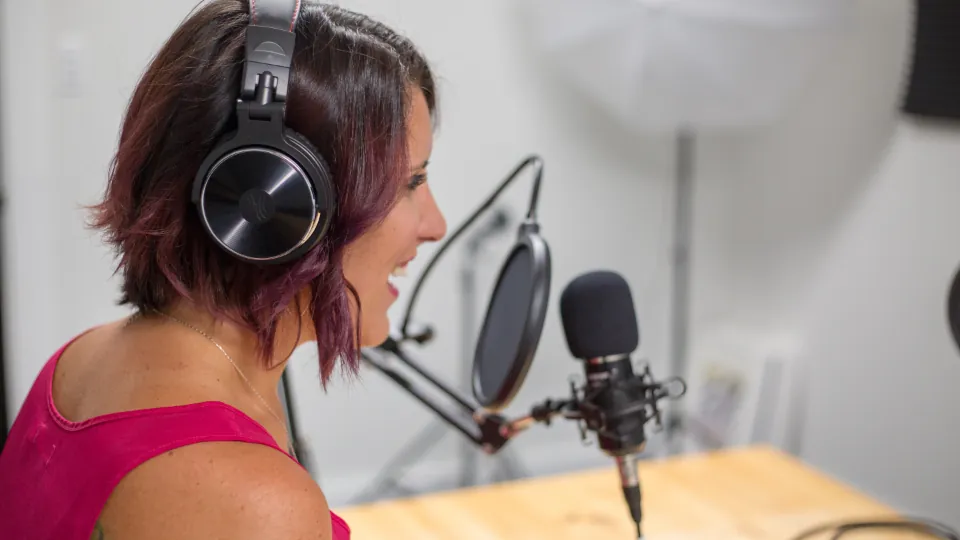
Photo: Ylanite Koppens / StockSnap (CC0)
Table of contents
Think back to an interview answer that felt messy. Chances are the problem wasn't the content. It was the shape: one long sentence that started with "So, in my previous company, which is a startup in Jakarta that focuses on…" and halfway through, you forgot where it was going.
Long sentences are a common trap when speaking a second language. In Indonesian, chaining clauses with "yang" (which), "dan" (and), and "jadi" (so) sounds perfectly natural. In English, the same pattern forces you to manage tenses, word order, and pronouns all at once, while nervous. This article explains why short sentences work better and how to practice them.
Why short sentences work
There are three practical reasons.
They're easier to say. Each short sentence is a finished unit. You can breathe, then start the next one. You don't have to remember how the sentence began.
They contain fewer grammar mistakes. Tense and word-order errors appear most often in the middle of long sentences, especially after "which", "that", or "because". Short sentences remove those danger points. The most common errors are listed in common grammar mistakes in interviews.
They're easier to follow. On a video call, the audio may break up, and the interviewer may be taking notes. Short sentences with one idea give them time to absorb each point. They also remember your points better when they score you.
The rule of thumb: 12 words, one idea
Keep two simple limits in mind:
- About 12 words per sentence. It's not a hard rule, but a comfortable limit. If you run out of breath, the sentence is too long.
- One idea per sentence. If you're about to say "and also" mid-sentence, stop and start a new one.
Then connect your sentences with simple linking words:
| Purpose | Linking words |
|---|---|
| Order | First, Then, After that, Finally |
| Cause and effect | So, Because of that |
| Contrast | But, However |
| Addition | Also, On top of that |
| Example | For example |
| Result | In the end, As a result |
With these, your answer flows, even though each sentence is short.
Before and after
Question: "Tell me about a project you're proud of."
Before (one sentence, about 60 words):
"So the project that I'm proud of is when I was in my previous company which is a logistics startup where I was asked to build a tracking dashboard for the operations team because they were using Excel and it was very slow and many mistakes happened so I built it with React and Node and after that the mistakes reduced a lot."
After (six short sentences):
I'm proud of a tracking dashboard I built.
It was for the operations team at a logistics startup.
They tracked shipments in Excel, and it caused many mistakes.
I built a web dashboard with React and Node.
The team started using it within two weeks.
After that, they made far fewer data entry mistakes.
The content is nearly the same. But the second version is easy to say, easy to follow, and each sentence stands on its own. If you have real numbers for the result, such as error counts before and after, include them. If you don't, never make them up; an honest description is enough.
Second example: "Why do you want to work here?"
Before:
"I want to work here because I think your company is very good and I saw on your website that you are building products for small businesses which is something that I also did when I was freelancing and I think I can contribute a lot and also learn many things from the team."
After:
I want to build tools for small businesses.
I saw that this is your main focus.
As a freelancer, I built order systems for small shops.
So I understand how these owners work.
I'd like to bring that experience to a bigger team.
Notice that the second version is also more specific. Short sentences force you to pick one point per sentence, which stops you from leaning on generic lines like "your company is very good".
How to break up a long sentence
During practice, take an answer you usually give, write it down as you'd say it, then break it up:
- Find "which", "that", "where", "because", and "and". That's usually where the sentence can be cut.
- Turn clauses into new sentences. "...a startup which focuses on logistics" becomes "It was a logistics startup."
- Move time words to the front. "Last year, I built..." is clearer than "I built it last year", because the tense is set from the start.
- Cut filler words. "Actually", "basically", "you know", and "like" can often go without changing the meaning.
- Read it aloud. If any sentence makes you stumble, break it again.
A short-sentence answer template
This five-sentence pattern works for many questions:
[Direct answer in one sentence.]
[Context: where and when.]
[What you did.]
[The result.]
[What you learned, or how it connects to this role.]
It's close to the STAR method, but tighter, and it fits a 30–45 second answer.
Common mistakes
- Short but generic. "I am hardworking. I am a team player. I like learning." Short, but empty. Short sentences still need specifics: project names, tools, real results.
- Sounding robotic. If every sentence has exactly five words and the same pattern, you sound stiff. Vary the length a little and use linking words.
- Cutting in the wrong place. "I built. A dashboard. For operations." Those aren't short sentences; they're broken ones. Each sentence needs a subject and a verb.
- Repeating the same subject. "I did X. I did Y. I did Z." Change the opening sometimes: "Then", "After that", "The team…".
- Trying to restructure live. Breaking sentences apart in real time is hard. Do it in practice, so the short pattern is already a habit in the interview.
Checklist for one answer
Before you call a practice answer ready, check:
- The first sentence answers the question directly.
- No sentence is longer than about 12 words.
- Each sentence has one idea.
- There's at least one specific detail: a tool, a real number, a project name, or a role.
- Linking words connect the sentences.
- The answer is 3–6 sentences, except for self-introductions.
- Everything in it is your own real experience.
Summary
Short sentences are the simplest way to sound clearer and more confident in English. Aim for about 12 words, one idea per sentence, and link them with simple words. Break up long sentences during practice, not mid-interview, and keep the content specific and honest.
Repartee follows the same principle: answer scripts are 2–4 short sentences, about 12 words each, no idioms, built only from experience in your profile. You can try it free for 20 minutes to see what a short answer to your own questions looks like.
Related articles
 Technical
6 min read
How to Explain Technical Trade-offs in English
A simple formula for explaining technical trade-offs in English interviews: options, context, decision, cost, and when you'd change, with sample answers.
 English
6 min read
Indonesian Accent in English Interviews: Should You Change It?
An Indonesian accent is not a problem as long as you're easy to understand. Learn which sounds cause misunderstandings most and how to practice them well.
 Communication
6 min read
Small Talk at the Start of an English Interview: Examples
How to handle the casual chat at the start of an English interview: common opening questions, short sample answers, and a smooth move to the main part.