Meeting Phrases in English: Interrupt, Agree, Disagree
 6 min read
TL;DR
In a meeting, you do not need long sentences. You need a few short phrases for each job: interrupt, agree, disagree, ask, summarize, move on, and take an action. Learn one or two per group and the freeze goes away.
Key takeaways
- Pick one or two phrases per job instead of memorizing a long list.
- To disagree politely, start with what you agree with, then give your concern.
- Do not open a disagreement with 'But'. Use 'I see it a bit differently' instead.
- Say 'sorry' once when you interrupt, not before every sentence.
- If you are not sure, say 'I'll confirm and get back to you' instead of guessing.
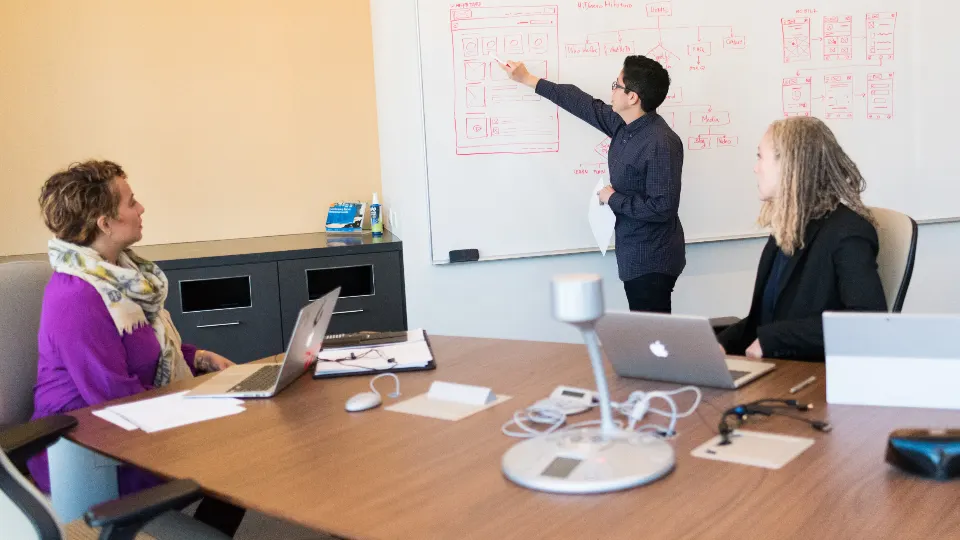
Photo: Christina Morillo / StockSnap (CC0)
Table of contents
You understand what your colleagues are saying. You have an opinion. But the right words come one second too late, and the topic has already moved on. Many Indonesian professionals know this feeling in international meetings. Reading English is easy. Jumping into a live conversation is hard.
This article gives you meeting phrases in English, grouped by what you need to do: interrupt, agree, disagree, ask, summarize, change the topic, and take an action item. Each phrase is short on purpose. Short sentences are easier to say under pressure, as explained in short sentences make answers clearer.
How to interrupt politely
Interrupting is normal in meetings, but the timing and tone matter. Wait for a small pause if you can. Then use a short signal.
Sorry to jump in. Can I add something?
Can I say something quickly?
Before we move on, I have one point.
Sorry, can I stop you there for a second?
Use the first one when you have a point to add. Use the last one when you need to fix a misunderstanding right now. If someone keeps talking, wait for a breath and say their name first.
How to agree and add
Agreeing is easy, but "Yes, yes" alone can sound flat. Add a small reason or a next step.
I agree. That makes sense to me.
That's a good point. I'd add one thing.
I think so too. It also helps with the deadline.
Exactly. I can support that part.
The pattern is simple: agree, then add one short thing. This keeps you in the conversation without a long speech.
How to disagree politely
This is the group most people fear. The idea is to disagree with the idea, not with the person. Start with something you agree with, then give your concern.
I see your point. I see it a bit differently.
I understand the plan. My concern is the timeline.
That could work. I'm not sure about the cost.
Can we look at another option?
I'm not sure that will work for us. Here is why.
If you need more careful wording, add "I might be missing something, but" before your concern. It shows respect and keeps the door open.
Too blunt, or better
| Too blunt | Better |
|---|---|
| No, that's wrong. | I see it a bit differently. |
| That will not work. | I'm worried it might not work. Can I explain? |
| But we don't have time. | I agree with the goal. My concern is time. |
| I don't agree. | I'm not sure I agree. Can we check the data? |
| You didn't understand. | Let me explain it another way. |
The better versions are not longer by much. They just add a small softener.
How to ask someone to explain
Asking for more detail is a strong move, not a weak one. It shows you are listening.
Could you explain that a bit more?
What do you mean by "phase two"?
Can you give me an example?
Do you mean we should start next week?
If you did not hear something at all, use the phrases in phrases when you don't understand the question. They work in meetings too.
How to summarize what you heard
Summarizing proves you understood, and it catches mistakes early.
So, if I understand correctly, we will launch on Friday.
Let me check that I got this right.
To summarize, we have two options.
So the next step is to test it first. Is that right?
End with a question, such as "Is that right?" Then the other person can fix any mistake.
How to move to the next topic
If you lead the meeting, or the talk is going in circles, move it forward gently.
Should we move on to the next item?
Let's come back to this later.
I think we can take this offline.
Can we park this and look at the budget?
"Take this offline" means to talk about it outside the meeting. It is common, but only use it if your team uses it too.
How to take an action item
When a task lands on you, say it clearly. It protects you and the team.
I can take that one.
I'll send the draft by Wednesday.
I'll do the first part. Can someone help with the second?
Always add a day or a time. "I'll send it soon" is too vague.
How to say you are not sure yet
You do not need to answer everything in the meeting. Guessing is worse than waiting. Be honest and give a time.
I'll confirm and get back to you.
I need to check with my team first.
I don't have that number now. I'll send it today.
Then really send it. This one habit builds trust faster than a perfect answer. If you need a few seconds before speaking, see phrases to buy thinking time.
Habit traps for Indonesian speakers
- Starting a disagreement with "But". In Indonesian, "tapi" at the start of a sentence is normal. In English, "But, we don't have time" can sound sharp. Use "I agree, and my concern is..." or "I see it differently."
- Saying "sorry" too much. One "sorry" when you interrupt is polite. Three in one minute makes you sound unsure. Replace extra ones with "Can I add something?"
- Translating word by word. "I want to ask" is fine, but "Can I ask a quick question?" sounds more natural.
- Staying silent to be polite. In many international teams, silence means you agree or have nothing to add. If you have a concern, say it briefly.
- Giving a long reason first. Start with your point in one sentence. Add the reason after.
Practice in ten minutes
Pick one phrase from each group and write it on a note. Before your next meeting, read the note once. During the meeting, your goal is small: use one phrase, not all of them. After the meeting, write down which one worked.
Summary
You do not need perfect English to take part in a meeting. You need a small set of short phrases: one to interrupt, one to agree, one to disagree politely, one to ask, one to summarize, one to move on, and one to take or delay an action. Disagree with the idea, not the person, and avoid opening with "But". Say "sorry" once. When you are not sure, say you will confirm and then do it.
Repartee is a Windows desktop app with a Meeting mode (Rapat). It listens to the meeting audio, shows the transcript with an Indonesian translation and the gist of the question, and drafts short English replies based only on your own meeting notes and profile. It never invents experience, and you still say the words in your own voice.
Related articles
 English
6 min read
Daily Standup in English: Example Sentences You Can Use
Daily standup update example sentences for yesterday, today, and blockers, plus a fill-in template and three complete standups for non-native speakers.
 English
6 min read
English for Online Meetings with International Teams
A practical guide to English for online meetings: prepare, greet, ask people to repeat, speak up in short sentences, and close with clear action items.
 English
7 min read
Project Status Update in English: Structure and Examples
How to report progress to a client in English with five simple parts, plus a 40-second spoken example, a written example, and how to report a delay.