English for Online Meetings with International Teams
 6 min read
TL;DR
English video meetings get easier with small preparation: read the agenda, prepare two sentences, and learn a few phrases for asking people to repeat. Start with short contributions, then add more over time.
Key takeaways
- Read the agenda before the meeting and prepare two sentences you want to say.
- Start small: greet people and confirm that your audio works.
- Asking people to repeat and confirming what you heard is polite and normal.
- Speak in short sentences, one idea each.
- Close by restating your own tasks so nothing is misunderstood.

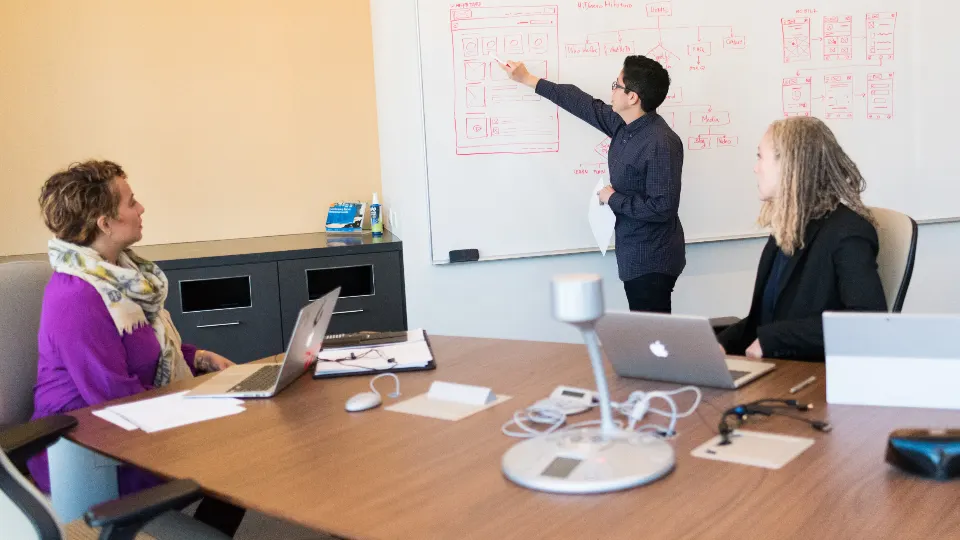
Photo: LinkedIn Sales Navigator / StockSnap (CC0)
Table of contents
You can read English documents without trouble, but when an online meeting starts, everyone speaks quickly and you are still processing the first sentence. This is common for professionals and freelancers who work with international teams. English for meetings feels harder than reading or writing because you have to understand and respond in real time.
This article walks through online meeting English step by step: before the meeting, the opening, understanding fast speech, speaking up, and closing. Each section has short meeting phrases you can use right away, with a note on what each one is for.
Before the meeting: two sentences, ready
The best preparation for a meeting is not new vocabulary. It is knowing what will be discussed. Five minutes before the call:
- Read the agenda. If there is none, ask in chat or email: "Could you share the agenda before the call?"
- Mark your part. Find the topics that involve your work. That is where you will most likely be asked to speak.
- Write two sentences. One for your update, one for a question or a blocker.
- Say them out loud once. Your mouth needs practice, not only your head.
Here are two sentences for a work update:
I finished the login page yesterday.
I need feedback on the design before I continue.
These two sentences are enough to sound present and prepared. If the call is a job interview, you can check the technical side in Zoom and Meet setup for online interviews. For work meetings, the same ideas apply.
Start small: greeting and audio check
Many people wait until they feel "ready enough" to speak, and then the meeting is over. An easier way is to say one short sentence at the start. After that, the next time you speak feels lighter.
Hi everyone, good morning.
For greeting people when you join.
Can you hear me okay?
To confirm that your audio works.
I'm having trouble with my audio. Let me rejoin.
For technical problems, which are normal in online meetings.
Thanks for having me.
For a first meeting with a new team or client.
A simple greeting also gives your ears time to adjust to the accents and speed of the other people.
Understanding fast speech
This is the part that makes people tense. The good news: asking someone to repeat is normal in international meetings, even for native speakers. The key is to ask with a clear sentence instead of staying silent and nodding.
Sorry, could you repeat that?
To ask for a repeat.
Could you speak a little slower, please?
To ask the speaker to slow down.
I missed the last part. What was the deadline?
To ask for a specific part. This is more useful than just "repeat".
Let me check I understood. You want the report by Friday?
To confirm what you heard. This is the best habit in any meeting: say it back in your own words.
Could you type that in the chat?
For numbers, names, or dates that are hard to catch by ear.
If you did not understand the point of a question, not just the words, also see phrases when you don't understand the question. Those phrases were written for interviews, but they work in regular meetings too.
Speak up in short sentences
In a meeting, listeners cannot reread what you said. Short sentences are easier to follow, easier for you to build, and less likely to contain grammar mistakes. One idea per sentence is enough.
Compare:
I think maybe we could consider moving the launch because the testing is not finished yet and there are some bugs.
The testing is not finished. There are still some bugs. I suggest we move the launch.
The second version is clearer and easier to say. For more practice, see short sentences, clearer answers.
A few sentences that help when you want to join in:
Can I add something?
To enter the conversation politely.
I have a quick update on my part.
To report on your work.
I agree with that. One thing to add: we need a test date.
To agree and add one point.
I see it a little differently.
To disagree gently.
Can I take a moment to think about that?
To give yourself a few seconds before answering. More options are in phrases to buy thinking time.
Ask for clarification
Meetings often end with people who think they understood but did not. Asking during the meeting is much cheaper than doing the wrong work for a week.
What does that mean for my task?
To learn how a decision affects your work.
Who is responsible for this part?
To clarify who owns a task.
When do you need this by?
To ask for the deadline.
Can you give me an example?
For terms or requests that are still unclear.
If the team uses internal terms you do not know, ask once: "What does that term mean here?" A good team is glad to get questions like this.
Close with action items
This part is often skipped, yet it protects you the most. Before the meeting ends, restate your own tasks in short sentences.
Just to confirm, I will send the draft by Wednesday.
To lock in a task and a deadline.
Who will send the meeting notes?
To make sure someone writes notes.
I'll follow up by email today.
To promise a follow-up. Make sure you really do it.
Thanks, everyone. Have a good day.
To close politely.
After the meeting, send a short message with your tasks. Writing is easier than speaking, and the message becomes a record of what was agreed.
Common mistakes
- Staying silent for the whole meeting. One sentence at the start is much better than none. Others cannot know you understand if you never speak.
- Nodding when you did not understand. The cost shows up after the meeting. It is better to say "Sorry, could you repeat that?"
- Building long, perfect sentences. Long sentences make you stall. Break them into two or three short ones.
- Apologizing too much for your English. One "Sorry, one more time?" is enough. No long explanation is needed.
- Not stating your tasks at the end. Without confirmation, each person may remember the deadline differently.
- Practicing only during real meetings. Say your sentences alone first. A guide is in solo speaking practice for interviews.
Summary
English video meetings feel hard because you must understand and respond at the same time. Reduce the load with small preparation: read the agenda, prepare two sentences, and learn a few phrases for asking people to repeat. Start with a greeting, confirm what you heard, speak in short sentences, ask when you are unsure, and finish by stating your tasks. This skill can be trained, and every meeting is practice.
Repartee is a Windows desktop app with a Meeting mode (Rapat) that listens to the meeting audio, shows the transcript with an Indonesian translation and the gist of the question, and drafts short English replies. The drafts are based only on your own meeting notes and profile, never invented experience, and you still speak in your own words.
Related articles
 English
6 min read
Daily Standup in English: Example Sentences You Can Use
Daily standup update example sentences for yesterday, today, and blockers, plus a fill-in template and three complete standups for non-native speakers.
 English
7 min read
Project Status Update in English: Structure and Examples
How to report progress to a client in English with five simple parts, plus a 40-second spoken example, a written example, and how to report a delay.
 English
6 min read
Meeting Phrases in English: Interrupt, Agree, Disagree
Meeting phrases in English for interrupting, agreeing, and how to disagree politely, with short example sentences you can use in your next call.